
I’ve always been fascinated by space, but there’s something about the current moment that feels genuinely special. For the first time in decades, human spaceflight isn’t just about maintaining what we already have in low Earth orbit — it’s about pushing outward again. The prospect of astronauts travelling back toward the Moon, and eventually beyond it, fills me with a level of excitement I haven’t felt since reading about the Apollo missions as a child.
The upcoming Artemis 2 mission represents far more than a technical milestone. To me, it signals the beginning of an extraordinary new era in spaceflight — one where deep-space exploration becomes a lived, human experience again, not just something carried out by robots and probes. Seeing real people prepare to journey around the Moon, testing new spacecraft and systems designed for the decades ahead, makes the future of space exploration feel tangible and immediate.After more than half a century since humans last travelled beyond Earth orbit, this moment feels like a turning point — not just for NASA, but for humanity’s relationship with space itself.
What is Artemis II?
At its core, Artemis 2 is a test mission. It forms part of NASA’s wider Artemis programme — a series of missions designed to build capability for sustained lunar exploration and, ultimately, future missions to Mars. Unlike Artemis 1, which was uncrewed, Artemis 2 will carry astronauts on a roughly 10-day journey around the Moon.
The mission will not land on the lunar surface. Instead, the spacecraft will follow a free-return trajectory, looping behind the Moon before heading back to Earth. This approach allows engineers to test life-support systems, navigation, communications, and deep-space operations with humans aboard — all without committing to a landing.
The spacecraft and rocket
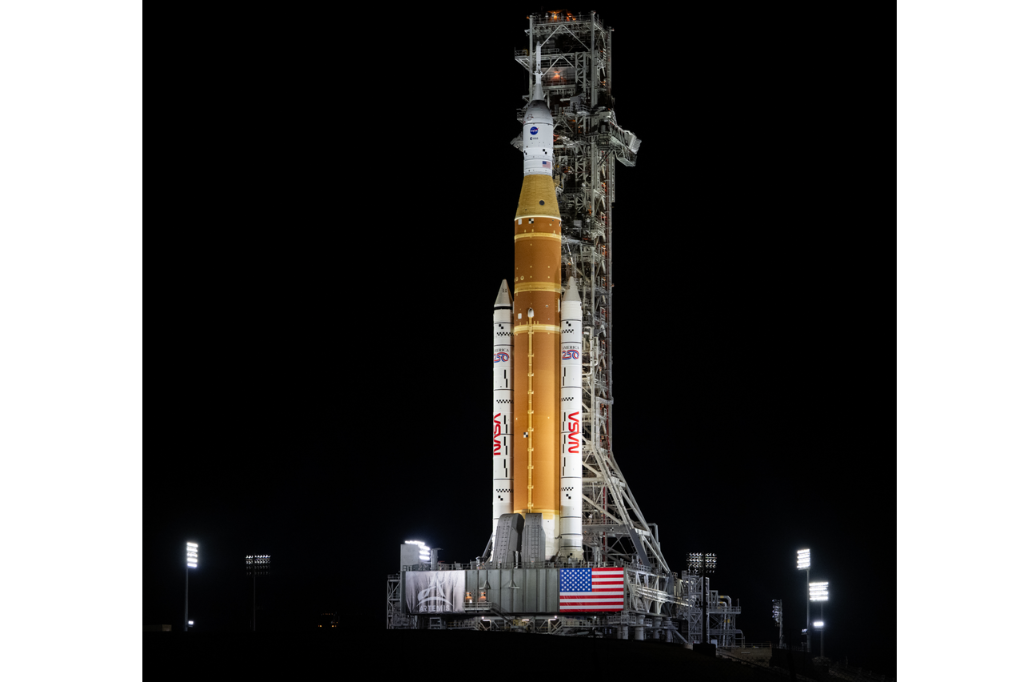
Artemis 2 will launch aboard NASA’s Space Launch System (SLS), one of the most powerful rockets ever built – it produces about 8.8 million pounds of thrust—roughly 15% more than the Saturn V. It’s a literal beast.
The Orion spacecraft sits on top. Orion has been designed specifically for deep-space missions and will carry the crew safely to the Moon and back.The mission also relies on the European Service Module, built by the European Space Agency, which provides propulsion, electrical power, air, and water — a reminder that modern space exploration is increasingly international.
Who’s on board?
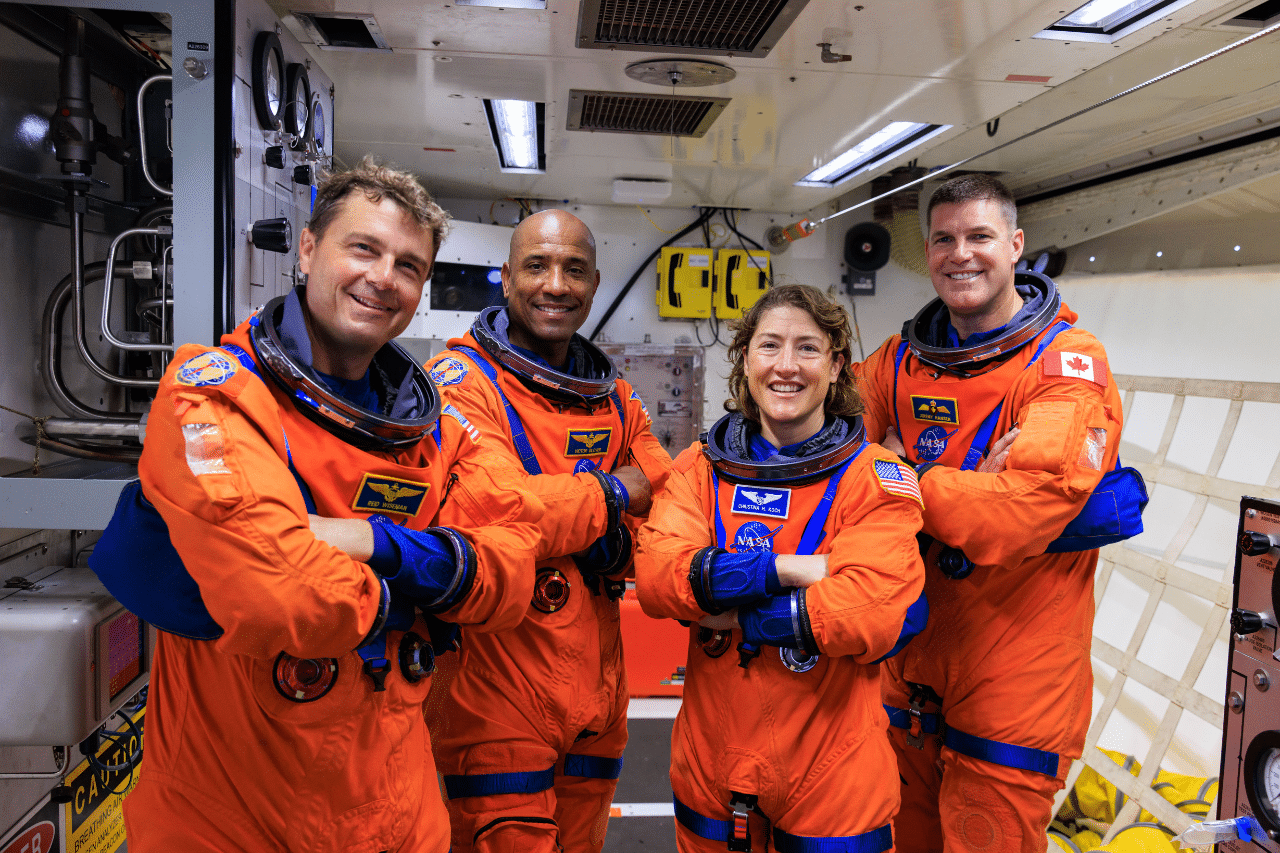
The Artemis 2 crew consists of four astronauts (pictured in the title image):
• Reid Wiseman (Commander)
• Victor Glover (Pilot)
• Christina Koch (Mission Specialist)
• Jeremy Hansen (Mission Specialist, Canadian Space Agency)
This team represents a diverse and highly experienced group, and notably marks the first time a non-American astronaut will take part in a U.S. crewed mission to the Moon.
Mission goals
The key objectives of Artemis 2 are to:
- Validate deep-space human operations aboard Orion
- Prove life-support, navigation, and communications systems in real lunar conditions
- Take astronauts farther from Earth than any humans have travelled in decades. To be specific, they’ll actually reach the furthest point from Earth ever achieved by a crewed spacecraft (at the apogee of their lunar swing-by), projected to be approx. 410,250 km from Earth.
- Build confidence in hardware and procedures ahead of future lunar landings, particularly Artemis 3
*In orbital mechanics, apogee is the point in an object’s orbit where it is farthest away from the body it is orbiting (in this case, Earth). When Artemis II performs its “lunar swing-by,” it isn’t just circling the Moon; it is tracing a giant, stretched-out loop. Think of it like a massive rubber band being pulled away from Earth, wrapped around the Moon, and snapped back.
Although it won’t land, Artemis 2 is a crucial stepping stone in NASA’s broader exploration roadmap.
Timing
As of early 2026, NASA is preparing the mission for launch from Kennedy Space Center. The rocket and spacecraft have been rolled out to Launch Complex 39B, where teams are carrying out final tests.
As is often the case with complex space missions, weather and technical checks have led to some schedule adjustments. A full “wet dress rehearsal” — a complete fuel-loading and countdown test — was delayed due to cold conditions, with launch opportunities now expected to begin in early February 2026 – hopefully Sunday 8th February 2026, but possibly extending into March and April.
Why Artemis II matters
At first glance, a fly-around mission might seem modest compared with a lunar landing. In reality, sending humans beyond Earth orbit again is an enormous milestone. Artemis 2 proves that NASA’s new rocket and spacecraft can safely support astronauts in deep space, bridging the gap between robotic exploration and sustained human presence.
It also reinforces international collaboration and long-term ambition — something no single robotic mission can achieve on its own.
Artemis 2 is more than a test flight. It is a symbolic and practical step into a new era of space exploration. As the first crewed mission of the Artemis programme, it re-opens the chapter of humans journeying to the Moon and lays the groundwork for future landings, scientific discovery, and — eventually — missions far beyond it.