
Steven Spielberg’s latest blockbuster Disclosure Day has done what only the best science fiction can — it’s made millions of people look up at the night sky and ask a genuinely serious question: is anyone out there, and could they actually reach us? As a Physics teacher, I find myself in the unusual position of being able to answer that with both enthusiasm and a dose of uncomfortable mathematics.
The short answer is: getting here from anywhere meaningful is almost impossibly hard. But “almost impossible” is not the same as impossible — and some of the workarounds theoretical physicists have proposed are stranger and more fascinating than anything Hollywood has imagined.

The Scale of the Problem
Our nearest stellar neighbour, Proxima Centauri, is 4.24 light years away. That means light itself — travelling at 300,000 kilometres per second — takes over four years to get there. The fastest spacecraft humanity has ever built, the Parker Solar Probe, travels at roughly 0.064% the speed of light. At that speed, reaching Proxima Centauri would take approximately 6,600 years.
And Proxima Centauri is essentially next door. The Milky Way is 100,000 light years across. The nearest large galaxy, Andromeda, is 2.5 million light years away. The numbers stop feeling like numbers and start feeling like a wall.
The Christmas Tree Analogy
Here is one of my favourite ways to think about why contact between civilisations is so improbable, even if intelligent life is relatively common. Imagine a Christmas tree with hundreds of lights — but they do not all stay on. Each one flickers on for a brief moment, then goes dark. The chances of two lights being on at exactly the same time are surprisingly slim.
Now replace each light with a civilisation. The universe is 13.8 billion years old. An intelligent species might emerge, develop technology capable of communication or space travel, and then collapse or destroy itself — all within a few thousand years. On a cosmic timescale, that is a blink. A civilisation a million light years away could have risen and fallen entirely before the light announcing its existence even reached us. By the time we detect the signal, the sender is long gone.
This is one of the most haunting ideas in all of science. It is entirely possible that the universe has been full of intelligent life — just never at the same time, or never close enough, or never overlapping long enough to make contact. We may be flickering on in an otherwise dark tree, with no other light currently burning within reach.
And if a civilisation does manage to survive long enough to attempt contact, they face the additional problem that any signal they send reflects where a planet was, not where it is. Navigation across interstellar distances means aiming at a moving target you can only see as it was thousands of years ago.

What General Relativity Actually Says
Einstein’s theory of General Relativity is unambiguous on one point: nothing with mass can reach, let alone exceed, the speed of light. As an object accelerates toward the speed of light, its effective mass increases — requiring ever more energy to accelerate further. To reach light speed would require infinite energy. The universe simply does not permit it.
There is also the time dilation effect to consider. A crew travelling at 99% of the speed of light would experience time passing far more slowly than observers back home. Theoretically, a crew could experience a journey of a few years while centuries passed on their home planet. Relativity makes interstellar travel survivable in human terms — but it makes return journeys and communication almost meaningless.
So the speed of light is not just a speed limit. It is a hard structural feature of reality as we understand it.
The Fermi Paradox — Where Is Everybody?
In 1950, the physicist Enrico Fermi asked a deceptively simple question over lunch: given the age of the universe, the billions of stars that could host habitable planets, and the statistical likelihood of intelligent life emerging elsewhere — where is everybody?
The universe is 13.8 billion years old. Earth is 4.5 billion years old. That means there could be civilisations out there billions of years more advanced than us. Even at speeds far below light, a sufficiently motivated civilisation could colonise the entire Milky Way in a few million years — a blink of cosmic time. So why the silence?
Possible answers range from the sobering (civilisations reliably destroy themselves before they reach the stars) to the unsettling (they are here but we cannot recognise them) to the oddly hopeful (we are genuinely early, and the universe is just getting started with life).
Could They Have Found a Way Around It?
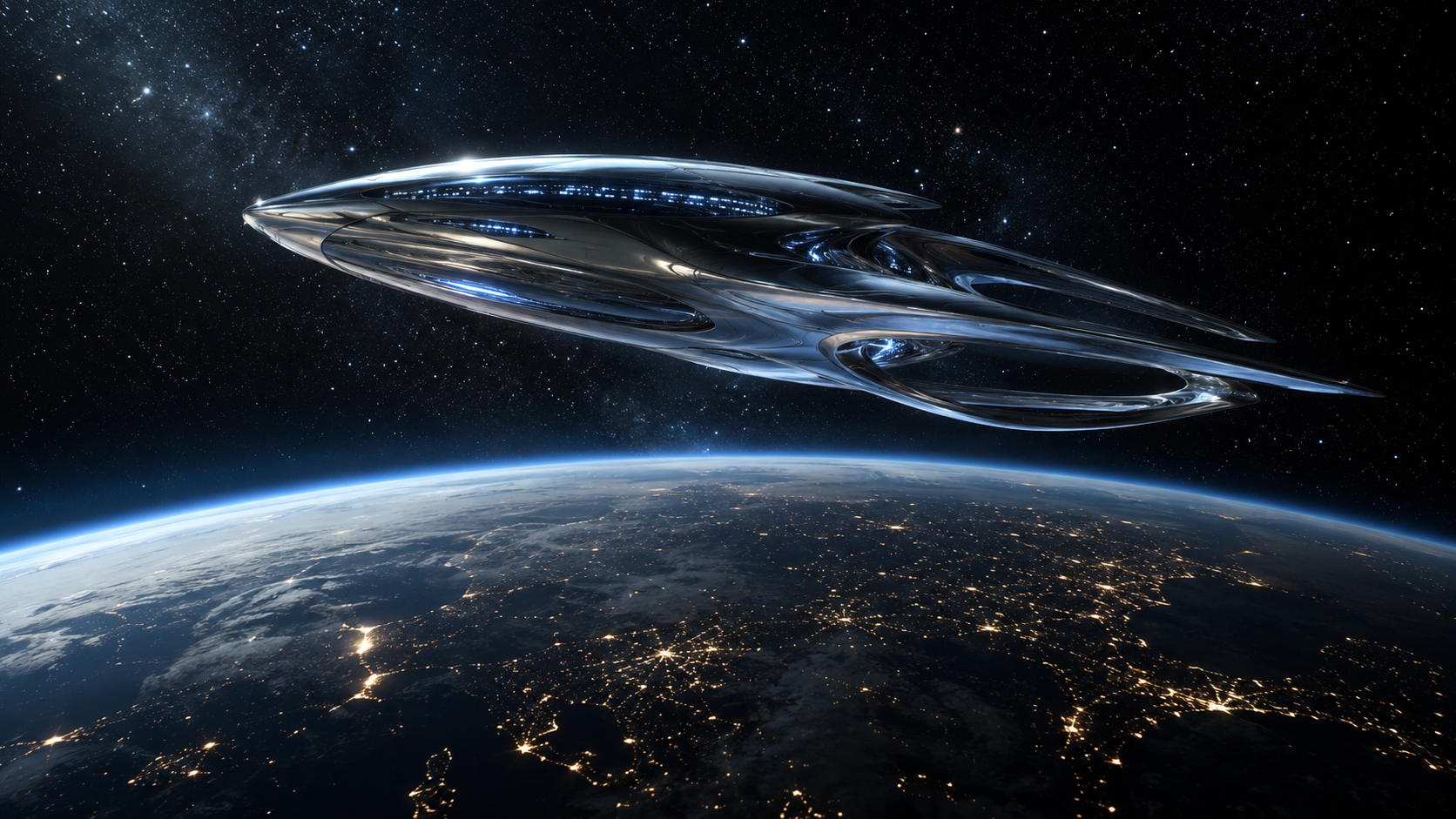
This is where it gets genuinely interesting — and where Physics stops being a barrier and becomes a set of very unusual possibilities.
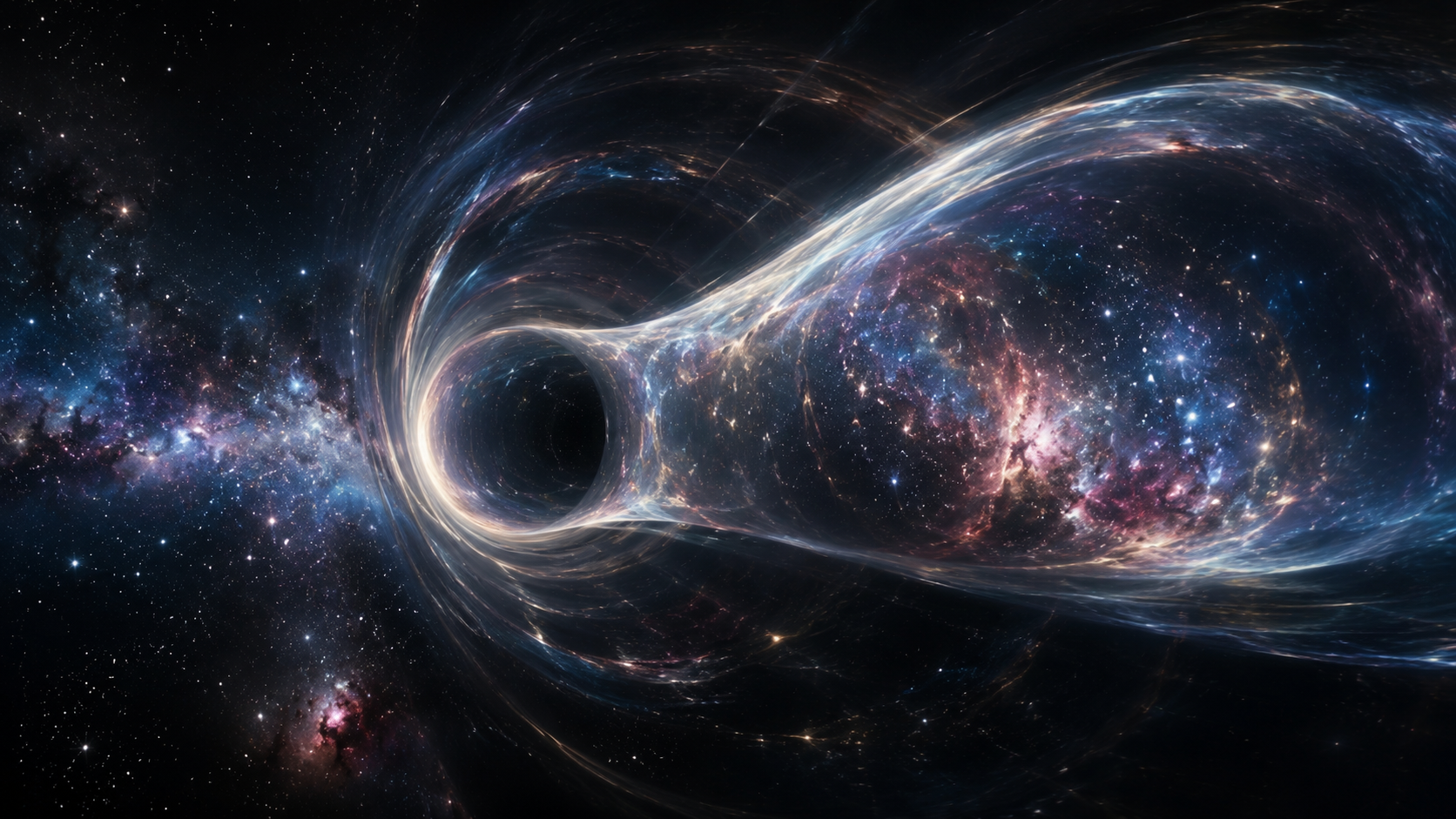
Wormholes. General Relativity itself permits the theoretical existence of wormholes — tunnels through spacetime connecting two distant points. Travel through a wormhole would not violate the speed of light because you would not be moving through space in the conventional sense — you would be taking a shortcut through its fabric. The problem is that no wormhole has ever been observed, they would require exotic matter with negative energy density to remain stable, and we have no idea how to create one. But they are not forbidden by the laws of Physics.
The Alcubierre Drive. In 1994, Mexican physicist Miguel Alcubierre proposed a theoretical propulsion concept that works by contracting spacetime in front of a spacecraft and expanding it behind — effectively surfing a wave of spacetime distortion. The ship itself would not move faster than light; the space around it would. Again, the energy requirements are currently incomprehensible. But again — not forbidden.
Generation ships. A civilisation patient enough might simply build enormous self-sustaining spacecraft where generations live and die over thousands of years of travel. No physics violations required — just extraordinary commitment and engineering.
Uploaded consciousness. Perhaps the most mind-bending possibility: a sufficiently advanced species might have moved beyond biological bodies entirely, transmitting their consciousness as information at the speed of light and reconstructing themselves at the destination. Not travel in any sense we would recognise — but arrival, nonetheless.
Could They Already Be Here?
The recent surge of serious institutional interest in Unidentified Aerial Phenomena — with governments declassifying materials and credible witnesses from military and intelligence backgrounds coming forward — has made this question harder to dismiss than it once was. Disclosure Day has brought that cultural moment to a mainstream audience.
The honest scientific position is: we do not know. The evidence for actual extraterrestrial visitation remains contested and unverified. But the dismissiveness that once characterised official responses has largely evaporated — replaced by genuine, if cautious, inquiry.
What we can say with confidence is this: the universe is 13.8 billion years old, contains an estimated two trillion galaxies, each with hundreds of billions of stars, many with planets in habitable zones. The idea that in all of that, across all of that time, only one small planet around one ordinary star produced intelligent life is — statistically speaking — a remarkable thing to believe.
Why This Matters for Physics Students
Every concept in this article — special and general relativity, time dilation, spacetime geometry, energy and mass equivalence — sits inside the GCSE and A-Level Physics curriculum. The equations are not just abstract exercises. They describe the actual structure of reality, including the limits and possibilities of what any civilisation, anywhere in the universe, can and cannot do.
Understanding Physics does not close down the question of extraterrestrial life. It opens it up — and makes it far more interesting than any film can.
If this kind of thinking makes Physics feel worth studying, The Hub Jam’s Practice Hub is where you build the foundations — one focused question at a time. Start free today.